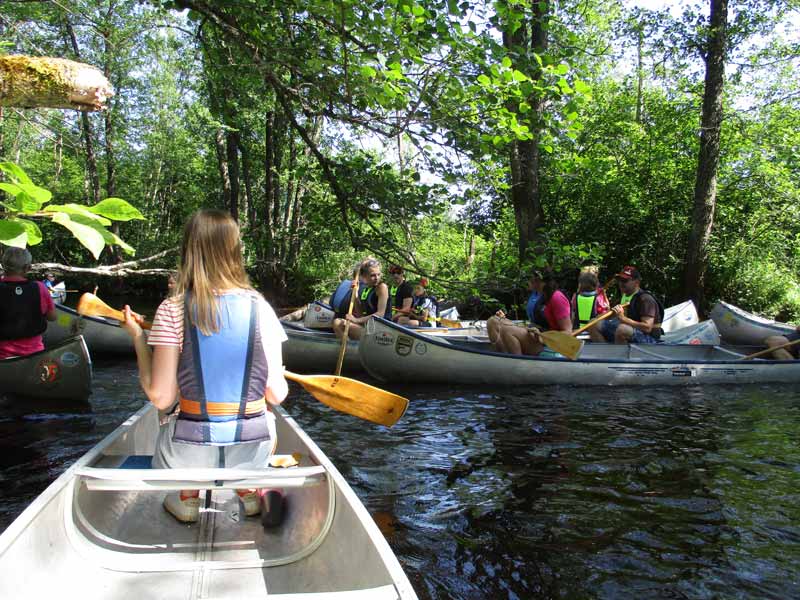
Sweden’s quiet lakes and waterways make for some wonderful opportunities for world-class canoeing. Nature Travels offers a range of 5 self-guided canoe tours with durations from 4 to 14 days. These flexible canoeing holidays are located in the county of Värmland in western Sweden. All take place on calm, slow-flowing rivers and lakes and feature wild camping all along the route. It is also possible to go fishing on all the tours – a dinner of freshly caught perch could provide the perfect end to a day’s paddling!

canoe1

Whichever canoe tour you choose, taking some time to hone your paddling technique will improve your enjoyment of your canoeing holiday in Sweden and help you move through the water as efficiently as possible – you may be surprised how much a little attention to your technique can save on tired muscles!

Our self-guided canoe holidays use aluminium-bodied open Canadian canoes, 5.25m in length. If you are an odd-numbered group, one person will simply paddle solo. This can take a short time to get used to if you have not paddled before, but otherwise should present few problems. Bear in mind if choosing of the extended wilderness canoe tours which require land transports, such as Canoe on Svartälven or Canoe in Bergslagen, that the solo paddler will require additional assistance during portages.

canoe3

Below we have given some basic advice on paddling technique to get you started:

How to Launch a Canoe

You may find it easiest to launch with as little weight in the canoe as possible, especially if the river has steep banks or difficult access. Try to put your canoe into the water parallel with the shore. Most steering is done from the back of the canoe, so the fittest and/or most experienced paddler should generally sit at the rear.

canoe5

Before loading luggage into the canoe, ensure that you are floating freely and will not ground on any stones, etc. Hold onto both sides of the canoe to steady it as you get in – the canoes are very stable and there is no reason you should capsize during your tour, but the most common time to fall into the water is when entering or exiting your canoe!

Similarly, when transporting the canoe over land, you will need to leave as little weight as possible in the canoe. Transporting a canoe full with luggage may damage your equipment.

canoe2

How to Paddle a Canoe:

In general, the persons in the front and back of the canoe should paddle on opposite sides. When you get tired, change sides. You should have most of the paddle blade in the water as you paddle and move the paddle in a straight line. Keep your paddling action close to the gunwale and try to paddle in the same rhythm as your partner, keeping the speed and force of your strokes roughly the same.

You can use the standard front stroke in reverse both as a braking stroke and to turn the canoe.

How to Steer a Canoe:

The person at the rear generally controls the majority of the steering. Use a “J-stroke” to make small course corrections as necessary with each stroke, being careful not to overcorrect. Begin your paddle stroke as normal but as you move towards the end of the stroke, rotate the paddle about 45 degrees – clockwise to turn right and anticlockwise to turn left – to guide the canoe.

If paddling across a large area of water such a lake, aim for a fixed point on the opposite shore and steer towards it – it can be easy to drift off course and paddle further than necessary!

canoe6

Our canoe tours in Sweden are accessible for both novice and more experienced paddlers and some tours are also suitable for families, even those with young children. Depending on the time available and your preferred level of challenge, you can choose between extended wilderness canoeing expeditions or a family-friendly canoeing holiday in rural areas.

For the truly adventurous, for 2009 we have even added the possibility to combine two of our longer routes together into one 14-day wilderness canoe tour, offering almost 200km of canoeing with the possibility to extend the distance paddled even further by planning detours into side lake and river systems. As well as being suitable for the more adventurous private paddlers, this combined route is also ideal for adventurous training for armed forces and cadet groups.

canoe4

Canoeing in Sweden is a seductive combination of tranquility, adventure and close-to-nature experiences – Happy Paddling!

This video shows survival expert Ray Mears canoeing in the area around Karlsborg to the south of Värmland:

You can find our more about Nature Travels canoeing holidays in Sweden and also our range of sea kayaking tours at www.naturetravels.co.uk/category-water.htm

Best regards

The Nature Travels Team

Nature Travels has just launched a new page on Facebook and also recently begun “tweeting” on Twitter, meaning there are now more ways than ever to keep updated on the latest outdoor and ecotourism holidays in Sweden:

FACEBOOK

In addition to regular updates on our experiences, the new Nature Travels Facebook page has a discussion board with a series of FAQs about our holidays in Sweden. We have answered some of the most common questions regarding our canoeing, kayaking and timber rafting experiences and will continue to expand this resource over the coming months. We also welcome your contributions – please submit your questions and we will be happy to assist.

The page also has a brand new Photo Gallery where we will be adding photos sent in by our clients from their holidays in Sweden. Some marvellous photos of early-season timber rafting have just been added.

news-facebook

TWITTER

With “tweeters” from Stephen Fry to Barack Obama, Twitter (www.twitter.com) is one of the latest innovations in social networking. The Nature Travels tweets (username: Nature_Travels) will provide regular bite-sized updates on the latest news additions to our portfolio.

news-twitter

WILD SWEDEN BLOG

Our blog at www.wildsweden.co.uk has been running since October 2006 and now has dozens of articles on topics on everything related to Sweden and the outdoors, from the conservation of the endangered Arctic Fox to how to choose a sleeping bag.

You can subscribe to the RSS feed from blog by clicking on the “Feed on: Posts” link on the page.

news-wildsweden

NATURE TRAVELS NEWS BLOG

Our news blog at http://naturetravelsnews.wordpress.com is also a fairly recent project. Here you will find regular updates on new outdoor experiences added to our portfolio and when new dates and prices for the coming season are released for existing experiences.

Again, you can subscribe to the RSS feed from blog by clicking on the “Feed on: Posts” link on the page.

news-naturetravelsnews

STEP FORWARD NEWSLETTER

If you prefer to receive your news via email, you can get an overview of the latest developments by subscribing to our bi-monthly email newsletter, Step Forward. You can read the latest edition online at www.naturetravels.co.uk/news.htm and sign up using the form at the bottom of the page.

We also publish two specialist occasional newsletters: Expedition Sweden, focusing on adventurous training in Sweden for Armed Forces, University Armed Forces and Cadets, and Paddle Sweden, spotlighting our range of canoeing, kayaking and timber rafting tours for canoe and kayak clubs. Sign up using the forms at the bottom of the page.

news-stepforward

As you can see, there is a wide choice of ways to keep ahead of the latest news on our range of holidays in Sweden! We also love to receive comments, photos and suggestions from our clients and are always happy to hear from you.

Best regards

The Nature Travels Team

Relaxing with a cold beer or glass or wine after a hard day’s paddling on one of our self-guided canoe tours in Värmland or hiking tours in the mountains of Lapland is one of life’s little pleasures. But you may find it harder than you think! In this series of FAQs, we look at some of the questions most frequently asked by our clients regarding Systembolaget – the Swedish national chain of off-licences.

system1

What is Systembolaget?

Systembolaget is a nationwide, government-owned chain of off-licences in Sweden. Systembolaget stores are the only places in Sweden apart from bars, restaurants and night-clubs where strong alcoholic beverages can be purchased.

When was Systembolaget introduced?

In the second half of the 18th century, following a series of unsuccessful attempts to regulate the consumption of alcohol in Sweden, all restrictions were removed by the king. This led to a rapid increase in the consumption and home production of alcohol. In 1830, the first society for moderation in drinking was started in Stockholm, and in 1850 alcohol first began to be regulated by the state. During and following the First World War, strict rationing was in place with the quantities of alcohol which could be purchased limited. This was abolished in 1955 when Systembolaget stores were introduced. In 1965 private stores were permitted to sell beer up to 4.5% abv, but this was reduced to 3.5% in 1977 following a dramatic rise in beer consumption.

Does Systembolaget have a monopoly?

Yes. In June 2007 an EU panel of judges ruled that Systembolaget’s shop monopoly was justified, though did lift restrictions on the private import of alcohol.

system2

Why is Systembolaget allowed to be only chain of off-licences in Sweden?

A number of regulations govern how Systembolaget stores are operated. One major reason for the monopoly being permitted is to enforce the minimum age law. Also, Systembolaget stores are prohibited from favouring particular brands, which in theory leads to a fairer choice for the consumer. Systembolaget can promote itself, but not individual products. All products are taxed on alcohol content rather than price, and all are sold with the same profit margin. Another advantage sometimes cited is that the enormous bulk buying power of the Systembolaget chain helps to keep prices down – Systembolaget is one of the largest buyers of wines and spirits in the world. Staff are well-trained and often surprisingly knowledgeable about the products on sale.

When are Systembolaget shops open?

Opening hours have been extended in some places in recent years. In larger centres, Systembolaget stores may be open Monday-Saturday, perhaps until 7pm on weekdays and 3pm on Saturdays. In smaller towns, opening hours may be restricted to weekdays and/or office hours only. In remote areas and small villages, the local store often operates as an extension of Systembolaget, where orders can be placed in advance for collection on particular days of the week

How do I buy alchohol in Systembolaget?

In some stores you can choose products off the shelf yourself as you would at the supermarket to pay at the till. In other stores, available example products are displayed behind glass cabinets. You write down the codes of the products you would like to purchase, take your order to the cash point and the assistant will fetch your items from the stores.

system3

What is the legal age to buy alcohol in Sweden?

To buy alcohol at Systembolaget you must be aged 20 years or over. To buy alcohol in a bar or restaurant you must be 18.

Do Swedish supermarkets sell alcohol?

Yes, but only beer up to Klass II or “folköl” (”people’s beer”), max. strength 3.5% abv. Stronger beers and other alcoholic beverages must be bought at Systembolaget.

Is alcohol in Sweden expensive?

Generally yes, but not always. Sweden certainly has a reputation for high prices for alcohol. In general, prices for beer, wine and spirits in Swedish bars and restaurants are likely to be higher than in the UK.

However, Systembolaget has a very wide selection to suit a range of tastes and budgets. Prices for a bottle of wine start from around 60 SEK (about £5). As products are taxed on alcohol content rather than price, some products can be quite competitively priced relative to the international market.

Light beers (up to 3.5% abv) are sold in supermarkets and are usually very affordably priced.

system4

Can I recycle cans and bottles in Sweden?

Yes. The price for all beer and other drinks cans includes “pant” or deposit, which will be refunded if you return the empty cans to a recycling station. Most supermarkets have a station outside the store, where you feed in your cans and then get a receipt which you can take to the till to exchange for cash or use as a discount on purchases. Don’t squash the cans! The machines will only accept them if they are intact. The same system also applies to plastic PET bottles.

The Systembolaget monopoly and restricted opening hours can seem strange to visitors from overseas, but in many ways the system functions very well. Provided you plan ahead and check local opening times, there is no reason why you should not be able to enjoy a glass of wine or cold beer after a day of outdoor activities in Sweden!

Best regards

The Nature Travels Team

For British people, the term “outside loo” is something strongly associated with a way of life from our parents’ or even grandparents’ generations, conjuring visions of portly housewives in aprons, working men in cloth caps and children with shorts and grubby knees braving biting winds to scurry down to the bottom of the garden and “spend a penny”. It is an anachronism from a time when families gathered around the “wireless” for evening entertainment, prices were reckoned in shillings and baths were taken in a tin tub in the living room on a Friday night.

utedass1

But in Sweden, a country at the very forefront of modern communications technology and with one of the highest standards of living in the world, the outside toilet or “utedass” is still very much alive and well and an essential part of Swedish outdoor life.

As we discussed in our article on Swedish summer houses, many Swedes have access to a cabin in the country which is regularly used at weekends and during holidays, and while most will have running water for cooking or washing, a great many of these summer houses will have outside toilets. This “old-fashioned” style of living which characterises the typical Swedish summer house is not only often a necessity dictated by the remoteness of the cabins and the physical distance to services such as mains water pipes, but for many Swedes is an integral part of the nature experience, a chance to escape the trappings of the modern life and take pleasure in a simpler way of living.

utedass2

As a result, the “utedass”, or dry compost toilet, remains a central feature of modern Sweden.

For visitors from overseas, asking for the loo and being directed to a small wooden shack in the forest can bring on a minor attack of culture shock. But there is no need to be concerned – Swedish dry toilets are a much pleasanter experience than you might expect!

When travelling to one of Nature Travels’ holidays in Sweden, you may encounter outside toilets on experiences such as our Romantic Adventure in Forest Log Cabin and Forest Weekend with Elk and Beaver Safari or at one of the mountain cabins on our extended dog sledding tours. Here are some of the questions we are sometimes asked regarding the Swedish outdoor toilet:

Are “utedass” found only in Sweden?

No, but they are particularly characteristic of and strongly associated with summer houses and remote cabins in Sweden.

utedass3

Are Swedish outdoor toilets comfortable?

Many summer house owners go to great lengths to make the “lilla huset” or “little house” as comfortable and pleasant as possible, decorating the inside of the cabin with flowers and photographs, thoughtfully providing books and magazines and even using polystyrene toilet seats to ensure exposed bottoms do not get cold!

Do Swedish outdoor toilets smell?

In many toilets you will find a bucket of earth or compost and a small cup, which should be used to sprinkle a covering of earth over the waste once you have finished. This not only helps the composting process but also controls odours. As a result, Swedish dry toilets should smell earthy but not unpleasant. In general, modern chemical toilets of the kind found at music festivals or public events are likely to have a much more unpleasant and aggressive odour.

Is it necessary to use the toilet if you just need to urinate?

Swedish outdoor toilets will generally be found in remote areas, and there is likely to be no-one else around when you need to go to the loo. To minimise odours and also to avoid filling up the toilet so quickly, it is best to use the Utedass mainly for solid waste. For liquid waste, a quick trip to the forest (especially for males) is the preferred solution.

utedass4

Do all Nature Travels experiences have outdoor toilets?

No! Our log cabins in Sweden are fully equipped with kitchens, showers, flush-toilets etc and furnished to a high-standard. Many of our other Sweden holidays, such as wilderness canoeing, timber rafting or sea kayaking feature wild camping, and on these experiences toilet facilities are not available. You will be given full instructions on how to deal with your toilet waste to ensure that you do not pollute the local environment, create a health hazard or leave any trace for travellers who may come after you.

As well as being a central part of Swedish outdoor life, dry composting toilets are a sustainable, environmentally-friendly alternative to flush toilets, requiring no power or chemicals for their operation and using no water. If you would like more information on composting toilets, including advice on how to build your own, visit the excellent Centre for Alternative Technology in Wales or download one of their factsheets.

Best regards

The Nature Travels Team

Whether you are on a wilderness canoe tour in Värmland, sea kayaking in the Stockholm archipelago or hiking in the mountains of Lapland, wild camping is a central feature of many Nature Travels Sweden holidays.

For all our activities featuring wild camping in Sweden, tents are either included as part of standard equipment or are available to hire as optional extras. In most cases, Hilleberg tents are used – a Swedish brand and one of the world’s best-known quality tentmakers. Hiring a tent will not only ensure that you are using equipment suitable for the experience but may also be the most convenient and affordable option. If you do not already have suitable equipment and do not plan to make regular use of your tent after your holiday in Sweden, buying your own may not be cost-effective. Hiring a tent also reduces your luggage when travelling and may also allow you to avoid baggage charges if flying with low-cost airlines such as Ryanair.

tents-2

However, if you participate in outdoor activities regularly, a good-quality tent is an essential investment. In this article we give an overview of different tent designs and discuss the pros and cons of each, discussing some points to consider when choosing a tent for your holiday in Sweden:

Ridge Tents

The “classic” A-frame tent design, stable in high winds and also less likely to sag in heavy snow if camping in winter, but often rather heavy and bulky and generally not suitable if you will be hiking and carrying your tent for long distances.

tents-ridge

Dome Tents

Dome tents have flexible poles which meet at the tent’s highest point. This is a spacious design given ample sleeping and storage area, but are not so stable in high winds so may not be the ideal choice for camping in exposed mountain areas.

tents-dome

Tunnel Tents

Tunnel tents have two or three flexible poles which are used independently. They are usually lightweight and provide ample legroom for taller campers, but can be unstable when exposed to wind from the side.

tents-tunnel

Traverse Hoop Tents

This design is often extremely lightweight, using one or two interdependent poles. However, traverse hoop tents will also be unstable in side-on winds.

tents-hoop1

Geodesic Tents

Using four or five flexible poles to make a self-supporting frame, geodesic tents offer an attractive combination of space and stability, but can be heavier than traverse hoop or tunnel designs.

tents-geodesic

Flysheet first or inner tent first?

Tents which pitch flysheet first have the advantage that the inner tent stays dry when erecting the tent in wet weather. There is also the option of using the flysheet by itself as a tarpaulin if weather conditions are suitable.

Tents pitching inner first generally give more space for sleeping as the inner sheet is stretched more tightly. If conditions are hot and dry, the inner tent can be used by itself.

What to think about when choosing your tent:

It may be useful to consider the following when choosing which tent is most suitable for your active holiday in Sweden:

  • What kind of terrain will you be travelling in? Are conditions likely to be particularly windy?
  • What time of year will you be travelling? What temperature range are you likely to encounter?
  • Does the tent have spaces for cooking and/or luggage storage? Being able to cook in one of the entrances can be useful in bad weather, but bear in mind that tents are not flame-proof and can catch fire very easily.
  • How important are the size and weight of the tent? Is luggage space limited? Will you be carrying the tent for extended periods?
  • Which of the basic designs described above is likely to suit your needs best?
  • How many people will sleep in the tent? Bear in mind that a tent rated as a 4-person tent may nevertheless feel rather cramped when filled with 4 campers plus luggage!

tents-1

Whichever option you choose, Sweden is one of the world’s top destinations for wild camping, whether you are on a 3-day sea kayaking tour, an 8-day wilderness hiking expedition or a 2-week canoeing holiday.

Happy camping!

Best regards

The Nature Travels Team

Sleeping mats are an essential but often undervalued part of your camping equipment. Prices may start at just a couple of pounds, but the old adage “you get what you pay for” is often as true with sleeping mats as it is for any outdoor equipment – economise on your sleeping mat at your peril!

mat6

A good night’s sleep is central to your enjoyment of any outdoor experience, and is especially important if you are planning to be out for an extended period, for example on one of our 7 or 14-day self-guided wilderness canoe tours in Sweden. Poor sleep will not only affect your mood, but you may feel tired and listless, be more sensitive to cold and may also find your judgement is impaired.

In this article we take a look at the different types of sleeping mat to help you choose which is most suitable for your camping holiday in Sweden, whether you are timber rafting through the forests of Värmland or trekking in Sarek National Park in Lapland.

mat5

In a previous article on choosing the right sleeping bag, we discussed that temperature ratings for sleeping bags are often calculated on the assumption that they will be used in conjunction with an appropriate sleeping mat. Your sleeping mat should not only cushion and support your body for comfort but also insulate you from below and is an essential component in keeping you warm while you sleep. Three times as much heat is lost by conduction (i.e. from your body to the ground) as from convection (from your body to the surrounding air).

There are a number of factors to consider when choosing a sleeping mat, for example:

  • How much the mat weighs and how small it packs relative to its comfort and insulating properties.
  • Whether you prefer a firm mat or a softer one.
  • Whether you will be using your mat only during summer or year-round.
  • What kind of mat you prefer (self-inflating, non-self-inflating or closed cell).
  • Your budget and how regularly you intend to use your sleeping mat.

To self-inflate or not to self-inflate?

Self-inflating sleeping mats: A self-inflating sleeping mat has a layer of foam which is contained within an airtight shell. To inflate the mat, a valve is opened drawing air into the foam. After a few minutes, the mat is fully self-inflated and the valve can be closed. When packing, you open the valve and expel the air by rolling the mat and then close the valve to stop air re-entering. Thermarest is probably the most well-known brand for this kind of sleeping mat (and they can even be converted into a chair!).

mat3

Non-self-inflating sleeping mats: Non-self-inflating mats, as the name suggests, must be inflated by the user. Air-only mats are unlikely to provide sufficient insulation for any use apart from summer camping, but non self-inflating mats may also be filled with down or synthetic insulation and are then much warmer. Though the mats themselves tend to be thicker than self-inflating models, as they do not have a foam layer inside they may weigh less and pack down smaller.

Bear in mind when inflating your sleeping mat that the moisture in breath can be damaging – water vapour may over time begin to rot the material inside. Some models allow you to use the sleeping mat storage sack as a bellows to avoid getting moisture from your breath into the mat.

mat4

Closed cell sleeping mats: This kind of mat does not inflate, but is simply a piece of foam. Budget priced mats tend to be of this design, but are generally best avoided as they are likely to have poor insulating properties, provide little support and may rip and mark easily.

mat2

However, good quality closed cell mats, such as the Thermarest Ridgerest, are also available.

mat1

Many Nature Travels holidays in Sweden feature wild camping, one of the great joys of the outdoors. While your sleeping mat is central to your enjoyment of your holiday, it is not always necessary to bring your own. On some of our experiences, such as our guided sea kayaking tours, camping equipment including high quality sleeping mats is included, while for other experiences, for example our range of self-guided canoe tours, it is possible to hire a sleeping bag package including bag, liner and sleeping mat as an optional extra.

Whichever option you choose, we wish you sweet dreams and a very enjoyable time camping wild in Sweden!

Best regards

The Nature Travels Team

(Nature Travels clients receive a discount of 15-25% for purchases both online and in-store with Cotswold Outdoor – simply quote the code printed on your booking confirmation when making your purchase. The code may be used for multiple purchases and is valid until 1st April 2010).

The freedom to camp wild beneath the stars is one of the principal attractions of many of our Sweden holidays, whether you are stretched out at the water’s edge on a timber rafting tour or camping in a tipi in the depths of winter on our Dog Sledding and Winter Bushcraft experience.

Having a good night’s sleep is central to your enjoyment of any outdoor holiday, and in this article we give an overview of points to consider when choosing a sleeping bag.

sleeping61

Rectangular or “mummy” bag?

Rectangular bags are comfortable and spacious, and have the advantage that you can open them out to use as a cover. However, such bags are mainly suitable for use in youth hostels and perhaps cabins in summertime. For camping or lower temperatures, a “mummy” bag will provide much better insulation.

Bags with tapered profiles are also available, offering some of the comfort of a rectangular bag while preserving some of the insulating properties of the “mummy” shape.

sleeping1

How a sleeping bag keeps you warm

A sleeping bag keeps you warm by trapping a layer of air which is then heated by your body. This seems an obvious point, but it is very easy to forget the less obvious implication: it is essential to be warm when you get into your sleeping bag! Your bag will not warm up properly if you get into it when cold.

Therefore, if you’re feeling cold before you turn in for the night, jump around and do some exercise and make sure you are feeling warm before getting into your bag. In cold weather, “doing the penguin” can be a good way to warm up (silly, but effective). Put your arms by your sides with your palms facing the floor and your fingers pointing out at right angles. Shrug your shoulders vigorously for a few minutes and you will feel the blood pumping to your extremities. A good way to warm up cold fingers! Having a hot drink while inside the bag is also an excellent way to warm up both you and your sleeping bag.

sleeping2

Should I choose down or synthetic insulation?

Each has its advantages and disadvantages. Down is an excellent insulator and is often the preferred choice for cold-weather bags. It is also much lighter than synthetic materials and has very good lofting properties, meaning that it can be compressed tightly and will still expand well. A down sleeping bag will generally have much better warmth-to-weight ratio than a synthetic bag. A good down bag will have at least 85% down and top quality bags may have 95% or more.

sleeping3

On the down side (!), down bags are generally more expensive than synthetic fillings. They are also unsuitable for wet or humid climates, as they take a long time to dry properly and lose almost all their insulating properties when wet. Your breath contains a lot of water vapour, and burying your head completely inside the bag may make it damp and cold from the inside. It may be better to sleep with your face exposed and wearing a hat or scarf. Ensure that you air your sleeping bag properly the following morning before packing it away for any extended period.

If you are buying a down bag, bear in mind that there are some animal welfare issues to be considered regarding the production and harvesting of down, so make sure your preferred manufacturer uses ethically-sourced fillings.

The technology used in synthetic fillings is improving all the time, and many people choose a synthetic bag as their preferred option. Materials such as Primaloft offer many of the advantages of down with the convenience of a synthetic bag.

sleeping4

Synthetic fillings are normally made from polyester filaments or sometimes fibre-pile. They retain much more of their insulating properties when wet and so are ideal for rainy or humid climates. They are easy to care for and clean and are normally more affordable than an equivalent-rated down bag.

However, synthetic bags generally have the disadvantages of being heavier and bulkier and may also have a shorter useful lifespan.

What do the temperature ratings on sleeping bags mean?

How you feel and react to the cold will vary enormously depending on your body, your energy level, your mood and many other things. The combination of these different factors means that while one person may be warm and comfortable in a particular bag, another person (or even the same person on a different day!) may feel chilly.

sleeping5

Many bags are rated with both “Comfort” and “Extreme” temperatures, which can be misleading. You may find that even if the label on your sleeping bag says “-20 degrees” you would feel very cold indeed using the bag at this temperature!

sleeping7

Bear in mind also that temperature ratings are sometimes calculated differently between manufacturers, and will be based on certain assumptions regarding how the bag is used, such as that you are using the bag with a suitable sleeping mat for insulation from below.

What should I think about when buying a sleeping bag?

When deciding which bag is most suitable for you, you should bear in mind the following:

  • What will you use the bag most for? You should choose a bag suitable for the situations and temperatures in which you will most commonly use it. If you only go camping in cold conditions very rarely, a lighter bag can be upgraded by placing it inside an extra bag or using  a thermal liner, but a polar bag will be uncomfortably warm outside the depths of winter!
  • If you know that you feel the cold, choose a bag with a rating higher than you anticipate needing.
  • Consider whether weight and/or bulk are important considerations. If so, you may want to opt for a down bag, but bear in mind that these are less suitable in damp conditions.

In the next article, we will be looking at options for sleeping mats and sleeping bag liners. In the meantime, sweet dreams!

Best regards

The Nature Travels Team

In September 2009, 100 years after Sweden’s first national parks, Sarek and Muddus in Lapland, were created, Sweden’s first Marine National Park will be inaugurated in the Koster Islands.

koster3

Lying just a short boat ride to the west of the coastal town of Strömstad between Sweden and Norway, the Koster archipelago has two main islands, North and South Koster. Surrounded by a beautiful archipelago of smaller islands, rocks and skerries, the car-free Koster Islands are Sweden’s most westerly populated islands.

koster1

Much of the land area of North and South Koster is already protected as a Nature Reserve. The Koster Marine National Park will cover around 45,000 hectares, protecting and conserving the unique natural marine heritage of the area.

The idea behind the Koster Marine National Park is to focus on a sustainable future for the islands, recognising both the economic importance of well-managed tourism and the biodiversity of the area. Koster is one of Sweden’s most popular coastal destinations during the summer but is also home to a number of species found nowhere else in Swedish waters. The waters surrounding the islands are also a vitally important inshore fishery for species such as lobster as well as a haven for wildlife, including a colony of common seals.

koster5

With its contrasts of deep and shallow hard-bedded waters, exposed and sheltered shallows and soft seabeds, Koster is in a class of its own as an area of marine biodiversity in Sweden. The Koster Fjord is connected to the Norwegian trench, which is turn connects to the edge of the continental shelf out in the Atlantic towards Norway, creating environmental conditions similar to deep ocean trenches. In time, it is planned that the Koster Marine National Park will connect with a similar protected area around the Hvaler Islands in Norway.

koster2

The Koster Marine National Park authorities plan to work in close collaboration with island residents to develop sustainable tourism and a sustainable economy on the islands. A new visitor centre is being constructed to showcase the importance of the area and provide a valuable educational resource for locals and visitors alike.

Koster is a wonderful destination for outdoor activities and offers some of Sweden’s best opportunities for sea kayaking holidays. We offer a range of guided and self-guided sea kayaking tours in the western archipelago, including Kayaking in the Koster Archipelago, a 3-day guided tour with wild camping.

koster4

Koster has always been a beautiful area to visit. With increased protection and greater national and international awareness of the value of archipelago’s marine environment, it should remain so for many years to come.

Learn more about Koster Marine National Park: http://www.youtube.com/watch?v=_mHCSVI6biB

Best regards

The Nature Travels Team

Sweden is having a beautiful cold, clear winter at the moment, with some of the best lake ice for years and temperatures from just below zero down to -30 or more. Winter is a wonderful time of year for a holiday in Sweden, but while the dry air may mean that you feel the cold much less than with equivalent temperatures here in the UK, it’s nevertheless important to dress properly in order to make the most of your Sweden holiday in the snow.

winterclothes1

Accommodation in Sweden is always very warm and cosy and you should have no problem staying warm inside, but when you are out and about enjoying your activities, whether you are dog sledding, ski touring or tobogganing with the kids, dressing appropriately is the key to enjoying your winter holiday.

In this article we outline some basic advice for dressing for the cold – it is not necessary to spend a fortune on specialist equipment to keep warm, though good quality outdoor clothing will almost always perform better and last longer than budget-priced gear. Nature Travels clients receive up to 25% on in-store and online purchases with Cotswold Outdoor, so why not treat yourself to some new kit before you set off?

winterclothes2

The Layer Principle

The advantage of layering is that you can easily adjust your clothing to achieve a comfortable temperature depending on your level of activity and weather conditions.

Base layer:

A good-quality base layer is one of the most important parts of your outdoor wardrobe (”base layer” sounds much cooler than “thermal underwear”!). The base layer manages moisture, wicking sweat away from your body. One important thing to remember is not to have any cotton material next to your skin. Cotton absorbs sweat and chills you.

Good synthetic base layers are available, but merino wool is one of the most popular materials. There have been some animal welfare concerns connected to the practice of “mulesing”, cutting around a sheep’s rear end to prevent disease, so it is important to ensure that your merino wool comes from an ethical source. If in doubt, ask the manufacturer or supplier of your chosen base layer.

Your base layer should have long-sleeved top and long-johns. Merino underwear is also available.

Mid-layer:

The function of the mid-layer is to insulate you from the cold, trapping and heating air close to your body. A good winter fleece or woollen sweater is ideal as a mid-layer.

Shell layer:

An effective shell (or outer) layer should keep out the wind, rain and snow. Suitable shell layers include windproof fleeces, softshells, mountaineering jackets, etc. For winter conditions in Sweden, a good mountaineering or ski/snowboard jacket is often ideal.

winterclothes5

Breathability and ventilation are important considerations – a shell layer with zips under the arms and/or on the sides can make it much easier to regulate your temperature, preventing sweat from building up, making you damp and chilling you.

On Your Legs

On top of your (non-cotton) underwear and base layer, you should have a good warm, windproof, snow/waterproof pair of trousers. Ski pants are ideal for many winter activities, including dog sledding and snowshoeing. Again, zips down the side allowing greater ventilation can be enormously helpful. It’s also good if the trousers are elasticated at the ankles or can be fastened by other means to keep out the snow. A pair of gaiters can also be useful for this purpose.

If you do not have or do not wish to buy dedicated winter/ski trousers for your trip, an effective “budget” alternative can be to use warm tracksuit trousers (over a suitable thermal base layer) with windproof and waterproof rain trousers over the top.

On Your Hands And Feet

Extremities such as fingertips and toes can feel the cold very easily. A good pair of windproof and snow/waterproof gloves is essential in cold weather. Cold hands and feet can not only ruin your experience of the winter wilderness but can also be potentially dangerous. Mittens are warmer than gloves with separate fingers. If you don’t wish to be restricted by mittens all the time, overgloves which convert standard gloves to mittens are an ideal solution and offer greater flexibility. If out on an extended tour such as one of our dog sledding holidays or snowshoeing expeditions, make sure you have a spare pair of gloves with you. Gloves are easily lost and the consequences may be very serious.

winterclothes3

Socks should be thick and woollen or synthetic (non-cotton). One solution recommended by Torkel, an experienced expedition leader and guide for our Snowshoeing in Wolverine Country and ski touring tours, is to use a thin (non-cotton) sock next to the skin with a plastic bag over it and a warm woollen sock on the outside. The idea is that the plastic bag will contain any moisture and keep the outer sock and boot dry. Always carry spare pairs of socks if out for more than one day.

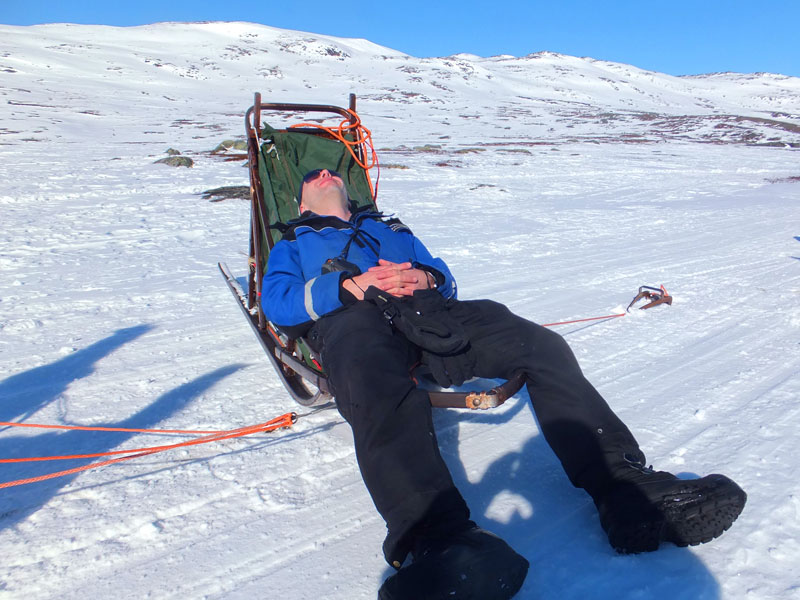
The 3-season hiking boots commonly used year-round in the UK are not really suitable for the sub-zero temperatures of a Swedish winter. Your boots should be  waterproof/snowproof and properly insulated (with some room to trap and warm air between the boot and your feet) with a good grip to give you stability on ice and snow. This is one piece of equipment which many clients may not have as standard, and if you are not planning to do activities regularly in winter conditions, you may wish to hire suitable boots for your experience rather than buying. Boots and other winter equipment (such as snowscooter overalls, a very warm option for dog sledding) are either included or can be hired as optional extras on many of our winter experiences in Sweden.

winterclothes4

On Your Head

A lot of heat can be lost through the head, and a thick woollen or fleece hat is important in regulating your overall temperature. Windproof hats can be even warmer, and it is useful if the hat can be adjusted to cover your ears.

A scarf or multi-purpose “Buff”-style headwear is a versatile piece of kit that can be used both to keep your neck warm and also to cover your face and nose.

Finally, ski glasses or goggles will not only keep the wind out of your eyes but also make it much easier to see where you’re going! If you wear glasses and are planning activities such as dog sledding, contact lenses can be a more convenient solution during your holiday – using goggles will be more comfortable and you will have fewer problems with fogging.

Down Jackets – ideal for breaktime

Down jackets are excellent for cold nights around the campfire and during rest breaks. However, they are likely to be too warm when active. As down is so light and compresses very well, down jackets are ideal for carrying in your pack for use in the evenings or when standing still for extended periods. As with merino wool, there are some ethical considerations regarding the sourcing of down for your chosen clothing. For more information, see clothing manufacturer Patagonia’s article on down at http://www.thecleanestline.com/2008/04/up-with-down.html. Synthetic alternatives such as Primaloft are also available.

There are many ways to enjoy the beauty of the Swedish winter landscape, whether you are looking for a traditional winter family holiday in the snow or the challenge and excitement of an extended dog sledding tour. Dress appropriately and you will be able to enjoy your Swedish winter holiday to the full!

Winter for many of us here in the UK is largely snow-free, but in Sweden it’s a very different story. In many areas of Sweden, the snow typically arrives in December and stays until the spring thaw around April. Throughout the winter months, Sweden’s vast areas of forest and mountains are covered in a thick blanket of snow and the lakes freeze over, with ice which may be several feet thick.

play

All of which make Sweden an ideal destination for a winter holiday, whether you would like to experience the challenge and adventure of dog sledding, combine Sami culture with the beauty of the Northern Lights on a reindeer sled safari, or take the children away for a traditional family-friendly snow adventure.

As an ecotourism company, Nature Travels does not offer downhill skiing or snowmobile safaris. But there is no shortage of excitement, as anyone who has commanded their own dogsled on an extended expedition into the mountain wilderness can tell you! We offer a wide range of dog sledding holidays and possibilities for cross-country skiing and snowshoeing in Sweden throughout the winter season for independents, families and groups.

For the young, the romantic and the young at heart, here are a few more ideas for ways to make the most of the snow and enjoy the beauty of the Swedish winter landscape:

Take a horse and sleigh ride

Our popular Winter Wonderland on a Forest Farm experience is ideal for families. Your hosts Lasse and Åsa will delight in taking you on a horse and sleigh ride through the magical forested winter landscape of Hälsingland.

horseandsleigh

Go sledging

Sledging is a time-honoured way to enjoy the snow, with or without the kids! It is often said that the Inuit have many words for snow – in Swedish there many words for things to sit on when going through snow, including “pulka”, “kälke”, “toboggan”, “snowracer”, “släd”, “stjärtlapp” (which translates as “bum patch”) and “ackja” (a traditional sled used by the Sami people in Lapland) .

Sweden’s gentle slopes provide the perfect terrain for sledging. Just don’t forget to brake!

toboggan2
Toboggan

snowracer
Snowracer

stjartlapp
“Bum patch”


Try kicksledding

An unfamiliar piece of apparatus for UK guests, kicksleds are perfect for getting around in the winter on slippery surfaces such as ice or hard-packed snow, and have been used in Sweden for centuries for everything from ice fishing on the frozen lakes to transporting the weekly shopping! Some people even use the family dog for a home-made dog sledding experience!

kicksled

Make snowlights

The combination of ice, snow and light always produces beautiful results. Snowlights are a simple but magical way to light up the Swedish winter evenings. Simply take a tealight, make some snowballs and build a pyramid around your candle. Then step back and enjoy the show! If you would like to try your hand at something more ambitious, visit the International Ice Sculpture Festival at our Country Manor Multi-activity Getaway experience between 9th and 21st February 2009.

snowlights

Dive in and make a snow angel

One of the easiest ways for artists to express themselves in the snow, but their simplicity and beauty means that snow angels have a timeless appeal!

snowangel

Build a snowman

There is nothing which reminds us more strongly of the traditional, Dickensian Christmases of our childhood (real or imagined) than building snowmen, and the activity is no less popular today. For a “classic” snowman, take three large balls of snow of decreasing size and stack them vertically. Complete the effect with a carrot or tennis ball nose and stones for the mouth and eyes. If there’s an old scarf and hat about, you can really bring your snowman (or snowwoman) to life!

snowman

Have a snowball fight

Sometimes the temptation is just too hard to resist, and an all-out snowball fight is a marvellous way to complete a day in the Swedish outdoors. As well as developing hand-eye coordination, reflexes and arm muscles, it’s also a great way to warm up when you’re getting chilly. Just remember to play fair, or the next snowball may be down YOUR neck!

A winter holiday in Sweden provides endless opportunities for fun in the snow, whatever your age. Let the games begin!

Best regards

The Nature Travels Team